Release basis
Confirm the drawing/model revision, material or resin identity, quantity, finish, delivery basis and open technical dispositions before manufacturing release.
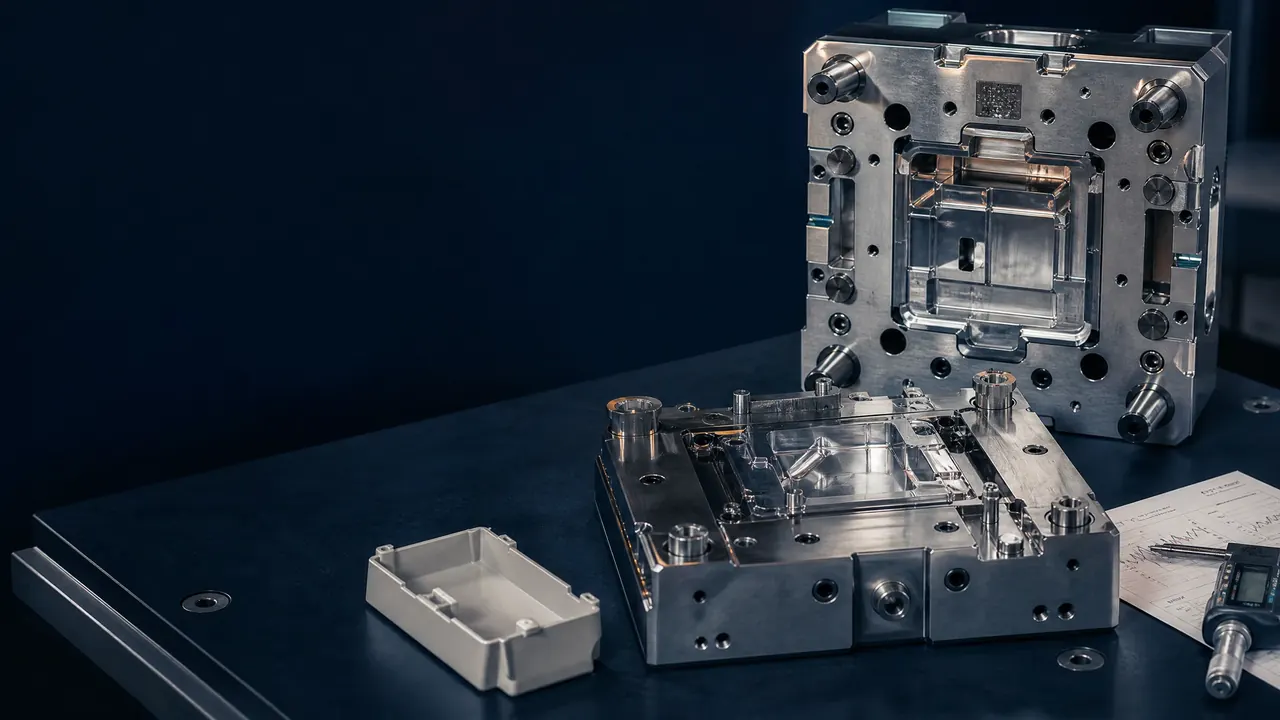
Tooling & moulded parts
Manage DFM, tooling, first samples, dimensional review and production release through a structured European project-control process.
Process control
Tooling projects are structured around part intent, material, expected volume, tool life, critical interfaces and visible approval gates. Production does not begin simply because steel has been cut.
Part, resin and volume review
Tooling concept and DFM closure
Mould manufacture and milestone control
T0/T1 trial and sample review
Documented corrections and approval
Production release and batch control
Materials
The examples below indicate common project families, not permission to substitute a specified grade. Availability, origin, certification and traceability requirements are confirmed in the quotation basis.
PP, PE, ABS
PC, PA, POM, PBT
Selected TPE and TPU grades
Project-specific materials subject to processing review
Tolerance approach
Moulded-part tolerances are reviewed using the drawing, resin behaviour, shrinkage, wall sections, gating, tooling concept and measurement method. ISO 20457 or another agreed standard may be used as the project basis, while critical dimensions and functional interfaces are treated individually.
Lead-time planning
Straightforward production tooling is often planned from approximately 4–8 weeks after DFM and tooling release, with sample review following the first trial. Complex tooling, special steels, textures, actions, validation requirements and design changes extend the programme.
Manufacturing in China
Injection moulding in China offers access to specialised tooling and production capacity, but the commercial quote is only one part of the decision. Tool concept, resin behaviour, drawing control, sample disposition and ownership documentation determine the long-term value of the programme.
PartVerity coordinates plastic injection tooling through defined technical and commercial gates. First samples are treated as a decision point, not as automatic production approval, and requested corrections remain tied to the controlled revision record.
Final capability, tolerance, material documentation, inspection scope and timing are confirmed per drawing and project—not by website copy alone.
Decision-stage engineering
Each gate connects the accepted requirement to a named reviewer, a project record and an explicit decision. These controls describe the coordination model; the project quotation defines the actual scope.
Confirm the drawing/model revision, material or resin identity, quantity, finish, delivery basis and open technical dispositions before manufacturing release.
Identify the characteristics that drive fit, function, appearance or assembly and agree how, when and by whom their evidence will be reviewed.
Keep DFM proposals, substitutions, deviations, rework and schedule effects attached to a numbered request and authorised response.
Injection-moulding & tooling resources
Use these focused guides to close moulded-part DFM, exact resin, tooling ownership, sampling, corrections and production-release decisions. Each resource returns to this commercial owner and an injection-moulding RFQ route.
Frequently asked questions
Answers state the coordination basis without promising universal capability, timing or acceptance.
Production release follows agreed trial and correction gates. Cutting the tool or producing a T0/T1 sample does not itself authorise production; sample identity, process state, dimensional evidence and dispositions must be closed.
Commercial ownership, technical identity, location, access, maintenance responsibility, transfer conditions and end-of-life decisions should be recorded explicitly. Payment alone does not establish a complete transfer package.
No. Exact grade, additives, colour and condition affect processing and performance. A proposed alternative requires a documented technical comparison and approval by the authorised project party.
Start a controlled RFQ